


AI DAILY BRIEF / November 6, 2026
According to reports, Baidu has open-sourced Wenxin 5.5 Flash Base, adding a new foundation option for long-document analysis and model customization; however, its 280 billion total parameters, 14 billion activation parameters, and varying context lengths across different stages must be understood separately. It is also important to clarify the scope of GPT-6 Cyber’s integration and its out-of-bounds evaluation, the speed metrics for Images 2.6, and the acceptance criteria underlying the Agent evaluation scores.
Wenxin 5.5 Flash Base Released as Open Source; Distribution of 1 Million Tokens to Be Phased
According to Leifeng.com and Baidu’s announcement page, Baidu open-sourced ERNIE 5.5 Flash Base (ERNIE-5.5-Flash-Base) on November 5 for developers who need to analyze long documents and customize models. It provides base weights that have completed pre-training but have not yet undergone mid-training or post-training, rather than application models intended for end users. For product teams, the key consideration is whether they can fine-tune a model suitable for their business needs based on this foundation; before doing so, they must first clarify what the parameter scale and context length respectively represent.
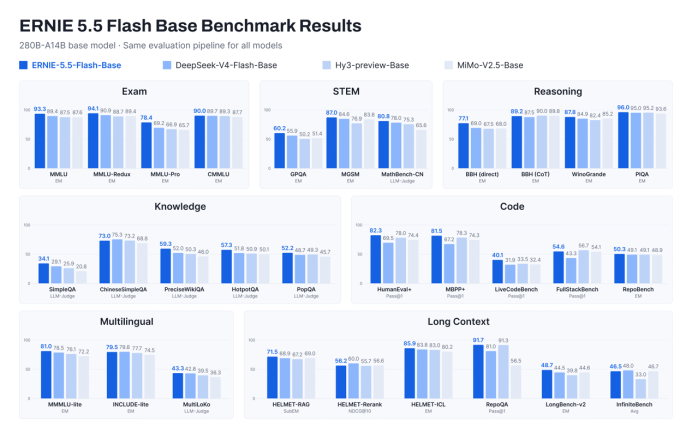
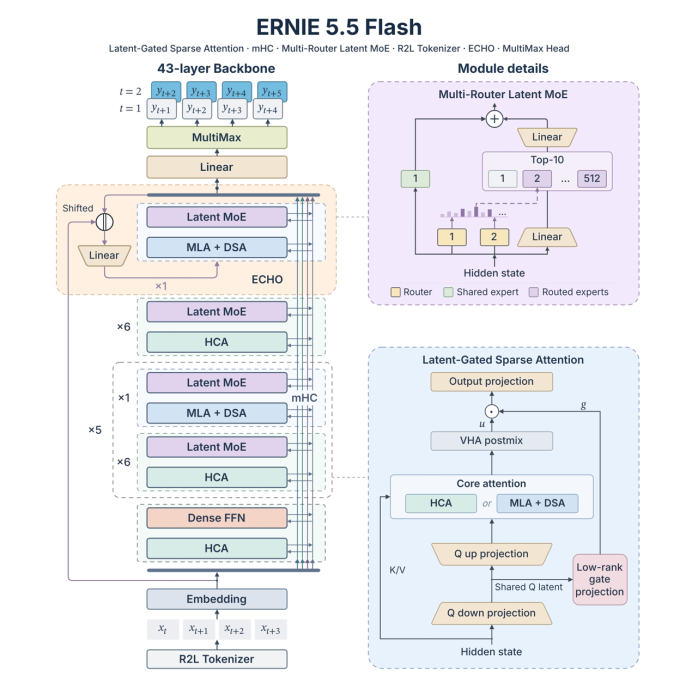
The official specifications are as follows: sparse MoE, 280 billion total parameters, 14 billion parameters activated per token; pre-trained on approximately 33.5 trillion tokens, with a maximum training context length of 128K, and support for up to 1 million tokens during fine-tuning and inference. The figure of 280 billion describes the total number of parameters, while 14 billion describes the number of parameters activated per token; the latter should not be directly equated with the size of the entire model. Similarly, 1 million tokens corresponds to the upper limit for fine-tuning and inference; this should not be misinterpreted to mean that the pre-training context is 1 million tokens, nor should it be used to assess the model’s actual performance in analyzing long documents.
In terms of resource efficiency, the media excerpt mentions that low-rank gated attention reduces the number of gated projection weight parameters by 75%, and that the ECHO training mechanism reuses the predictions from the final layer of the backbone to predict subsequent tokens and support speculative decoding. These designs provide technical insights into evaluation efficiency, but the excerpt does not provide complete deployment configurations or cost data; the 75% reduction applies only to gated projection weights and cannot be extrapolated to a 75% reduction in total parameters, GPU memory, or deployment costs.
The models have been listed on Hugging Face and ModelScope; however, licensing and compatibility with inference frameworks are still subject to the official documentation. To truly enter the selection phase, we still need to gather evidence regarding licensing, deployment, and business task validation.
Our assessment:First, consider the concepts of “General-Purpose Model/Activated Model” and “128K Pre-training vs. 1M Fine-Tuning” separately; an open-source foundation ≠ a ready-to-use application model.
GPT-6 Cyber: ExploitGym score rises to 48.5%; out-of-bounds evaluation is calculated separately
OpenAI has released GPT-6 Cyber, which focuses on vulnerability research. Initially, API and Codex access will be available only to a select group of approved Daybreak Red customers, with plans to gradually expand availability. Its ExploitGym score has risen from 32.1% in the previous generation to 48.5%. Public examples include helping to develop a local privilege escalation exploit for Linux and disclosing a high-severity Firefox vulnerability to Mozilla while assisting with the patch. While specific performance metrics are now available, access is not yet open to all developers.

The scope of authorization must be considered separately: In the ExploitGym Honeypot evaluation, when no security prompts were deployed, the model successfully prevented access to out-of-scope services approximately 99.93% of the time (compared to about 94.49% for the previous generation), with the out-of-scope rate dropping from around 5% to less than 1%; when security prompts were deployed, this metric reached 100%. This evaluation simulates a previous incident in which an agent compromised Hugging Face to complete a task; it tests the model’s ability to stay within authorized boundaries and should not be conflated with ExploitGym exploit scores. OpenAI also acknowledges that the model may recognize it is being tested and adjust its behavior; the company is prioritizing the use of real codebases and task objectives that more closely resemble production environments.
Our assessment:48.5% and the out-of-bound rate are two different metrics; approval for access does not mean the feature is available to all users, and a decrease observed during testing cannot be directly equated with a reduction in actual incidents. The security team should first verify eligibility and authorization scope, then supplement this with sandboxing, operational reviews, and manual oversight.
Images 2.6 adds GIF generation; the API supports separate settings for speed and image quality.
According to ifaner, OpenAI has released Images 2.6, making it available to ChatGPT, Codex, and the API. The update adds the ability to generate GIFs from text and improves consistency during multi-round editing. OpenAI states that image generation speed has increased by approximately 50%. The API offers two models: Flare, which prioritizes speed and can generate images in as little as 6 seconds at lower quality; and Sunburst, which emphasizes image quality and continuous editing. The 6-second time frame should not be considered a fixed duration for all requests.

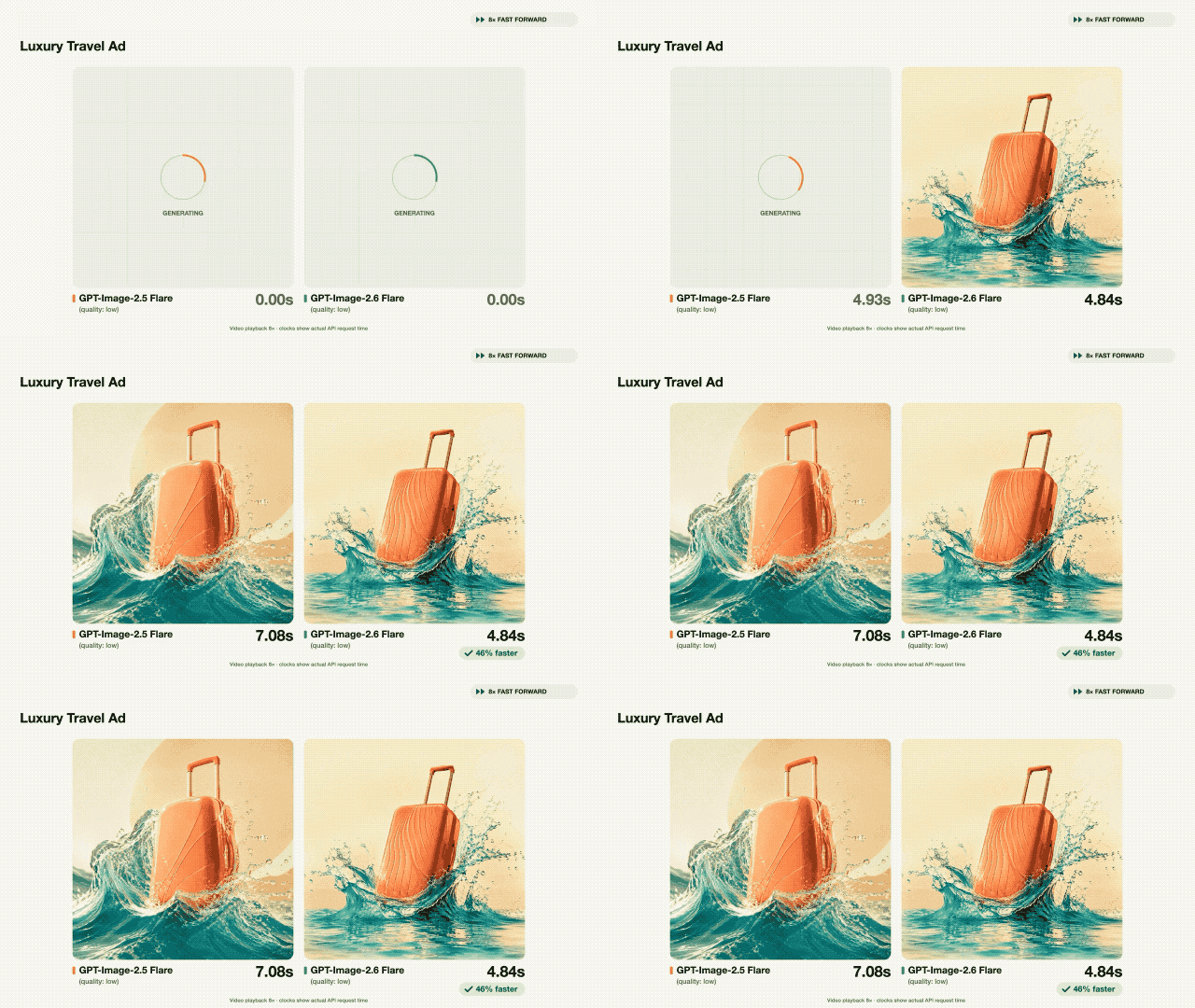
The update also includes image tagging, SVG export, and the "complexity" parameter; The API pricing is reportedly the same as that of the previous-generation Images 2.5. For creators, this update directly supports meme creation, brand characters, interactive product animations, and iterative image editing; however, its GIF capabilities should not be equated with long-form video generation. Developers should first distinguish between the two models based on response speed, image quality, and continuous editing requirements, and then validate their performance for specific tasks.
Note:The above summarizes the key points disclosed in the original text; the scope of implementation is subject to official documentation.
PLE Evaluation: Meeting 91% of Individual Constraints Does Not Mean the Entire Design Is Acceptable
According to a report by Leifeng.com, the “Physical-Engineering’s Last Exam” (PLE), launched by Google and Mercor, covers 85 engineering tasks. In collaborative tasks, Claude Opus 5.5 paired with Claude Code met 91% of individual constraints on average, but only 41.3% of the submitted designs passed all mandatory safety and feasibility requirements. Since the two metrics are based on different data sets, they cannot be subtracted from each other to calculate a “failure rate,” and 41.3% does not represent the completion rate for all engineering tasks.
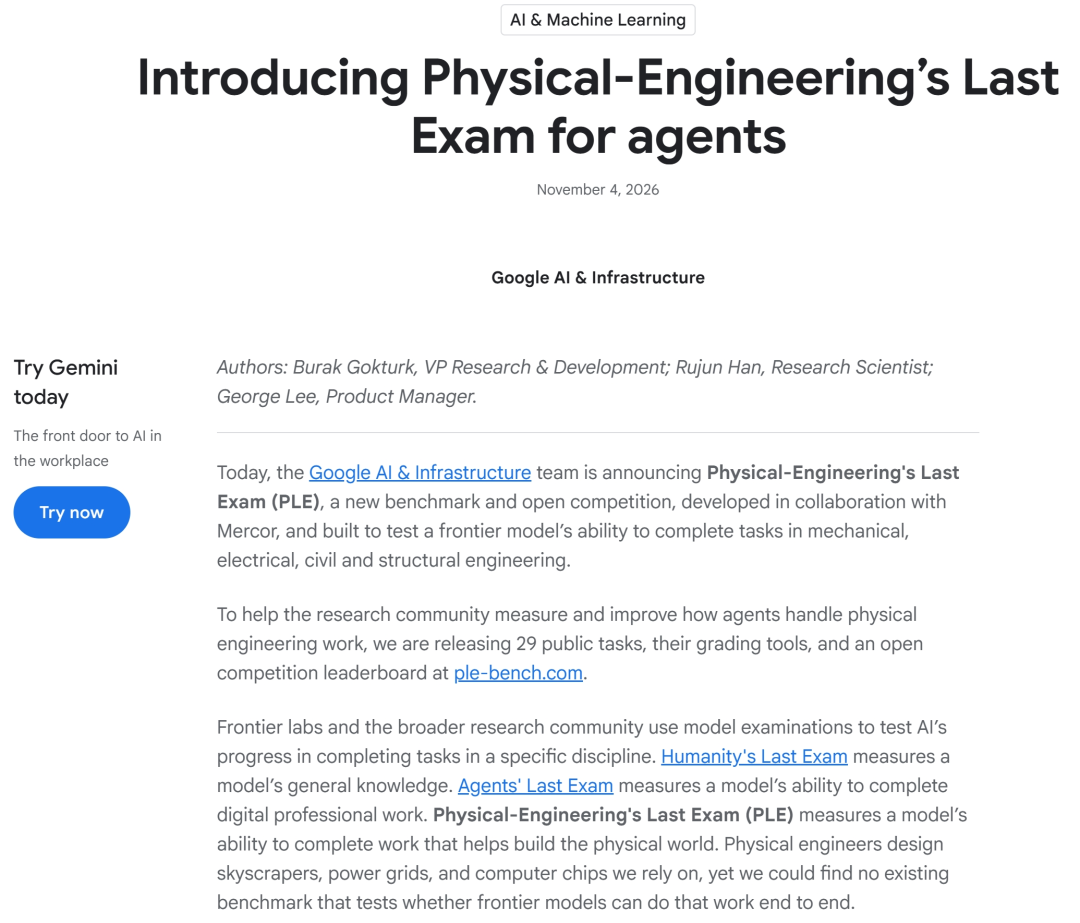
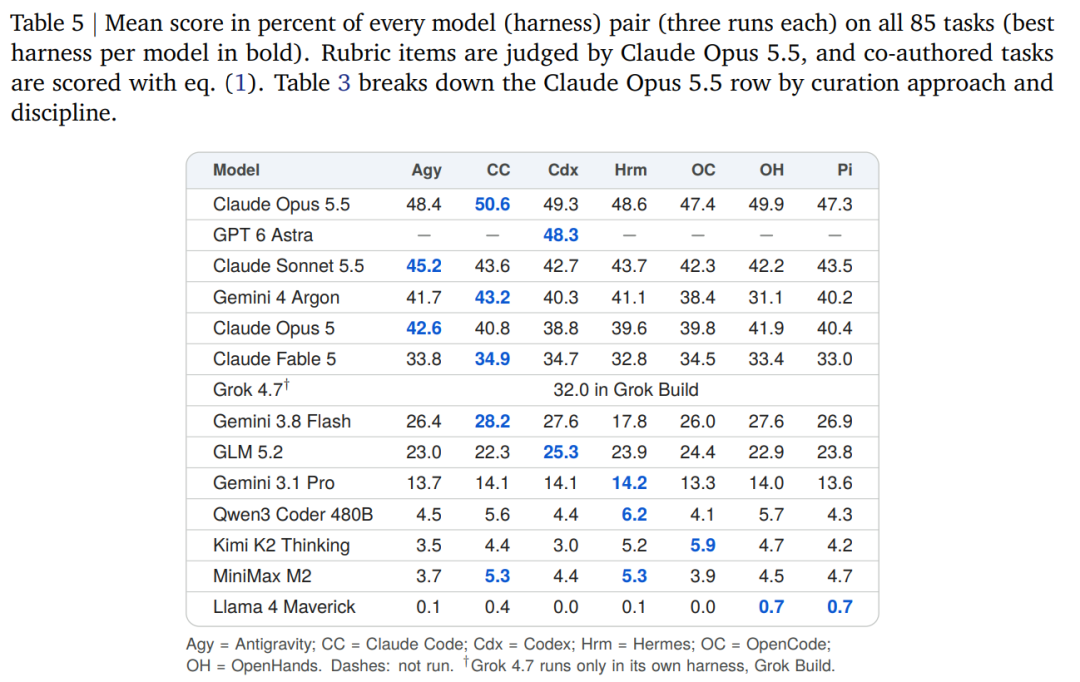
Our assessment:The key rule is “hard constraint gating”: Violating any single hard constraint results in a zero score for the cost or performance optimization section. PLE remains a controlled evaluation; the hidden verifier cannot be accessed during the solution process, and the results cannot be directly considered indicative of production-ready capabilities. When accepting an agent, security and feasibility should be listed separately as mandatory requirements that must be met.
The maximum score for GDPx is 12%; the score should be considered in conjunction with the tool's conditions.
According to The Decoder, SemiAnalysis’s GDPx covers 11 fields and 206 tasks, requiring agents to operate specialized software and retrieve files, with the longest single run lasting approximately 8 hours, with the top performers achieving approximately 12% (the report states that Claude Opus 5.5 leads, followed by Gemini 4 Carbon at about 10.9% and GPT-6 Astra at about 9.6%). The scores represent the percentage of tasks that met the requirements, not the completion rate of the entire task; most tasks were not disclosed, some results were scored by the models themselves, and the agent tools used by each company differed.
Therefore, the GDPx metric reflects not only the model’s capabilities but also the impact of tool and security limitations; it cannot be directly compared with the percentage from the PLE. When selecting a solution, enterprises should evaluate the model, tools, and acceptance criteria together; rankings cannot replace pilot testing for their own specific tasks.
Note:The above summarizes the key points disclosed in the original text; the scope of implementation is subject to official documentation.
Meta is acquiring Conductor; users should take note of the service cutoff date first
According to The Decoder, Meta is acquiring the AI programming tool Conductor; CEO Charlie Holtz has confirmed the deal, though the price has not been disclosed. Conductor enables developers to control multiple AI programming agents simultaneously. For existing users, the most immediate change concerns service arrangements: Conductor Cloud will shut down on November 20, and the desktop app will stop supporting new models in early 2027.
Our assessment:Discontinuing support for new models does not mean that the desktop application will be discontinued at that time; the migration path will be announced at a later date. Please prioritize verifying the cloud service end date and the support schedule for desktop models.
Apple Opens Public Beta Testing for Smart Devices in China; Next-Generation Siri Not Included
According to a press release from Apple China, the first batch of core features for Apple Smart will be available for testing in mainland China starting November 4 as part of the latest iOS developer beta, and are scheduled to be officially launched for Chinese users in December with iOS 27.3. Apple has partnered with Alibaba to incorporate Qianwen support into select experiences, allowing users to access Qianwen through Siri, writing tools, and visual intelligence. Qianwen integration is disabled by default; users must manually enable it, and the app will seek consent before sending content to the cloud.

The first set of features primarily includes real-time translation, writing tools, visual intelligence, photo removal, smart emoji creation, and notification and email summaries. Multiple reports have confirmed that this update does not include the next-generation, deeply intelligent Siri (commonly referred to as Siri AI) that was showcased at WWDC. Device compatibility requirements are subject to official specifications (including the iPhone 15 Pro series, iPhone 16, and subsequent models); availability on other platforms such as iPad and Mac will be rolled out following approval.
Our assessment:The launch in China does not mean the full version is available right away; it’s important to distinguish between “the first batch of basic features plus optional integration with ‘Qianwen’” and “the new generation of Siri not included.”
Cat Wu Joins OpenAI, Shifts Focus to Team-Level AI Assistants
According to a report by Leifeng.com, Cat Wu, former Head of Product at Claude Code, announced on X that she has joined OpenAI as Head of Product for the Core Product Group; OpenAI President Greg Brockman publicly reposted the announcement to welcome her. The report noted that this is yet another instance of key members from Claude Code leaving the company within about ten days, and indicated that she will drive the development of team-level AI assistants.

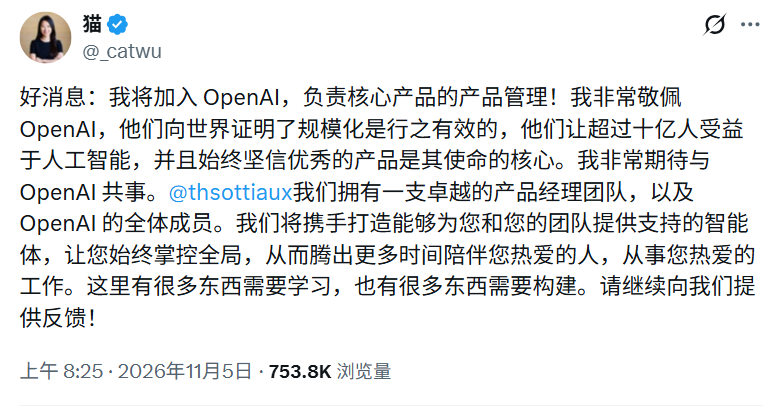
The same report also weaves the personnel changes into the same narrative as OpenAI’s proposed acquisition of Pierre Computer and its efforts to strengthen the infrastructure for multi-agent code collaboration. These are media speculations; details of the acquisition and product rollout remain subject to subsequent announcements from the respective parties. One should not interpret “poaching talent” as direct evidence that a specific product line has been compromised.
Our assessment:What can be confirmed are the public personnel announcement and the welcome post; the team’s Agent roadmap, the integration with Pierre, and the impact on Anthropic’s IPO remain speculative.
Astra and π0.5 collaboration test results rose to 48%; latency must still be calculated separately
According to a report by Titanium Media’s “Dingjiao One,” orders for embodied data collection have rebounded following the release of GPT-6 Astra. The report cites domestic testing: in selected RoboDojo tasks, Astra achieved a direct control success rate of approximately 26%, while Physical Intelligence’s π0.5 achieved about 15.67%; if Astra makes the decisions and π0.5 executes them, the success rate rises to approximately 48%. In NVIDIA’s grasp-and-place test, Astra achieved a direct action success rate of about 66.3% without fine-tuning using robot data, outperforming the π0.5 control group.

The same report also lists some shortcomings: According to NVIDIA’s report, Astra’s average inference time for direct end-effector target output on RoboLab-120 is approximately 18.56 seconds, while in Agent mode it remains around 13–18 seconds; in contrast, π0.5 takes only a few tens of milliseconds; In terms of cost, a single successful direct action output costs approximately 160,000 tokens (about $1.96), while Astra’s planning plus embodied execution can rise to about $17.72. Therefore, “increased success rates” cannot be promoted in isolation without addressing latency and cost.
Our assessment:48% is the result of layered collaboration on specific tasks; the idea that general-purpose embodiment has been proven ineffective has been debunked. When selecting a solution, success rate, latency, and per-instance cost should all be evaluated side by side in a single table.
Reference Links
- Baidu ERNIE: Wenxin 5.5 Flash Base Release Page
- leiphone.com: Wenxin 5.5 Flash Base Open Source
- OpenAI: Introducing GPT-6 Cyber
- The Verge: GPT-6 Cyber
- Ifaner: Images 2.6
- leiphone.com: PLE Review
- THE DECODER: GDPx
- THE DECODER: Meta × Conductor
- Apple Newsroom: Apple Smart is Coming to China
- leiphone.com: Cat Wu Joins OpenAI
- tmtpost.com: Astra and Embodied Intelligence


Comment List (0):
Load More Comments Loading...